
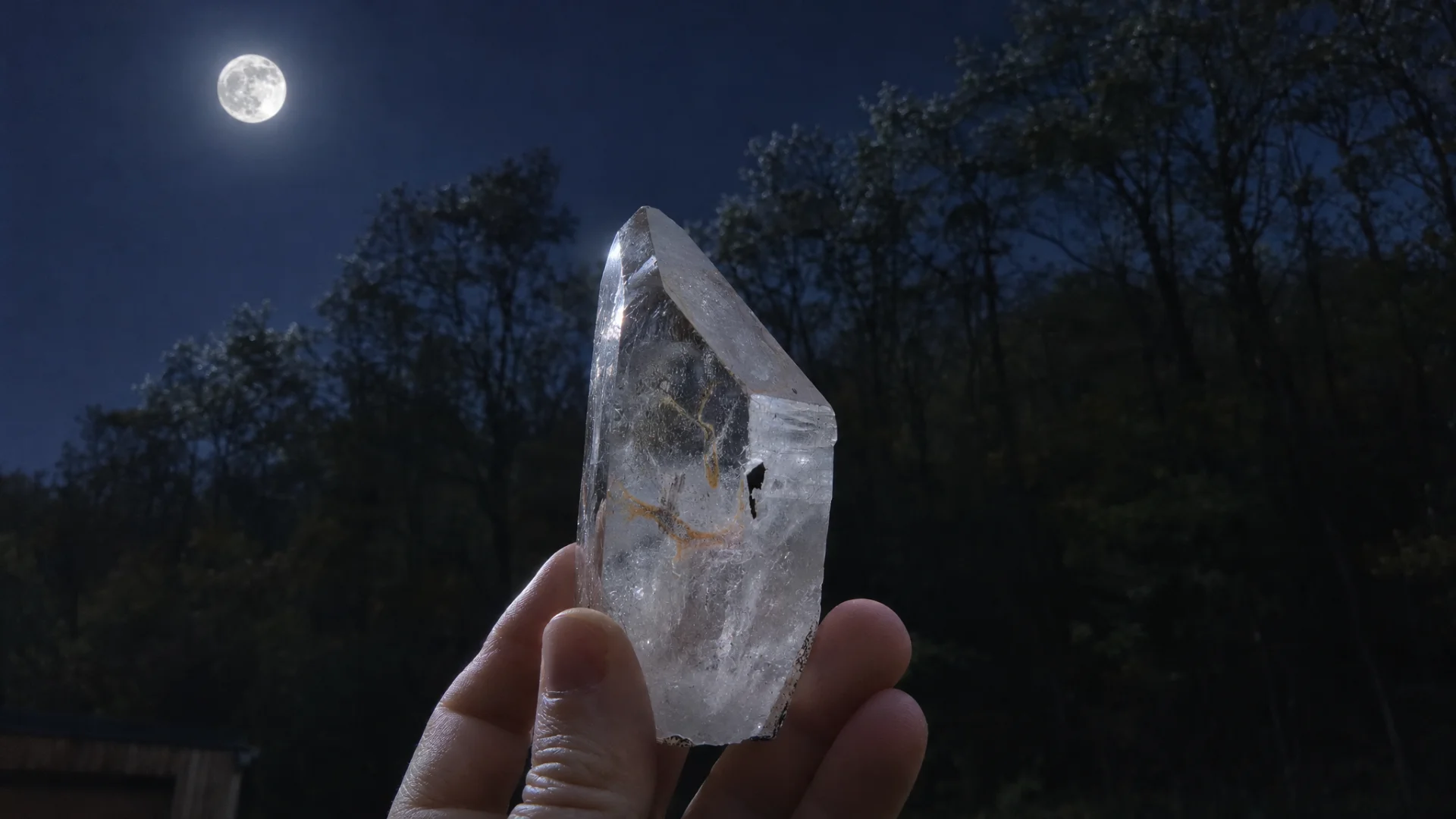

In essence, charging your crystal under the full moon is quite simple – put the crystal somewhere dry where the full moon can reach it, set your intention, and take it back before the sun comes up.
Moonlight itself won’t harm any crystal. What can harm it is everything else that comes with a night by the window: dew, rain, a narrow ledge, and the morning sun that arrives while you’re still asleep.
In crystal practice, the full moon marks the brightest point of the lunar cycle and is associated with completion and release. That is why it’s such a popular night to clear a crystal and give it a fresh intention at the same time.
Personally, I put my crystals on a windowsill where the moonlight can reach them. Leaving them outside puts my valuable pieces at too much risk. But smaller, less valuable crystals get the outdoor treatment – not because it would be better, but simply because it feels better.
Cleansing and Charging in One Night
The two words often get used as if they meant the same thing. A useful way to tell them apart: cleansing clears what the crystal has accumulated, and charging gives it a direction for what comes next. There is more on that distinction in our guide to cleansing crystals.
The full moon lets you do both in one sitting. Clear first, then name the intention you want the crystal to carry forward. If you don’t want to set an intention, the moonlight cleanse is enough on its own. You can charge another time, or not at all.
What Can Go Wrong Overnight
Moonlight is very faint compared with sunlight. NIST describes the Moon as roughly 400,000 times fainter than the Sun, so even a light-sensitive stone like amethyst can spend the night in it. The risks are about the place, not the light.
| What can go wrong | What to do about it |
|---|---|
| The morning sun reaches the windowsill | The full moon sets around sunrise, so the same sill may get direct sun the next morning. One morning won’t hurt, but don’t leave light-sensitive stones like amethyst there for days. |
| Dew, rain or condensation | Keep the crystal indoors and off any sill where a cold window mists up and drips. Selenite, malachite and lepidolite should stay dry altogether. |
| A fall from a narrow ledge | Use a wide, stable surface. Brittle stones such as moonstone and fluorite are more likely to chip from a knock than from anything else. |
| Losing it outdoors | A small stone in the grass is easy to lose, and the garden at night belongs to whatever lives there. |
If you don’t know what the stone is, or it is strung on a cord or set in metal, keep it indoors and dry. That way the night asks nothing of materials you can’t vouch for.
How to Charge Crystals Under the Full Moon, Step by Step
1. Check the date. The Moon looks full for a couple of days, so the night before or after works too if the exact night is cloudy or you’re busy. Your phone’s calendar or weather app will usually show the moon phase.
2. Check the crystal. Make sure your crystal isn’t too expensive to risk and doesn’t mind mist or water. Also, any cord, glue or metal has to be just as happy with a night outside as the stone is. But then again, charging it outside isn’t necessary.
3. Choose the spot. The full moon rises in the east around sunset and crosses the sky through the night. In the northern hemisphere, a window facing east, south or west catches it at some point; in the southern hemisphere, swap south for north. A wide windowsill, a table by the window, or a shelf with a view of the sky all work. Put down a dish or a folded cloth if the surface is hard.
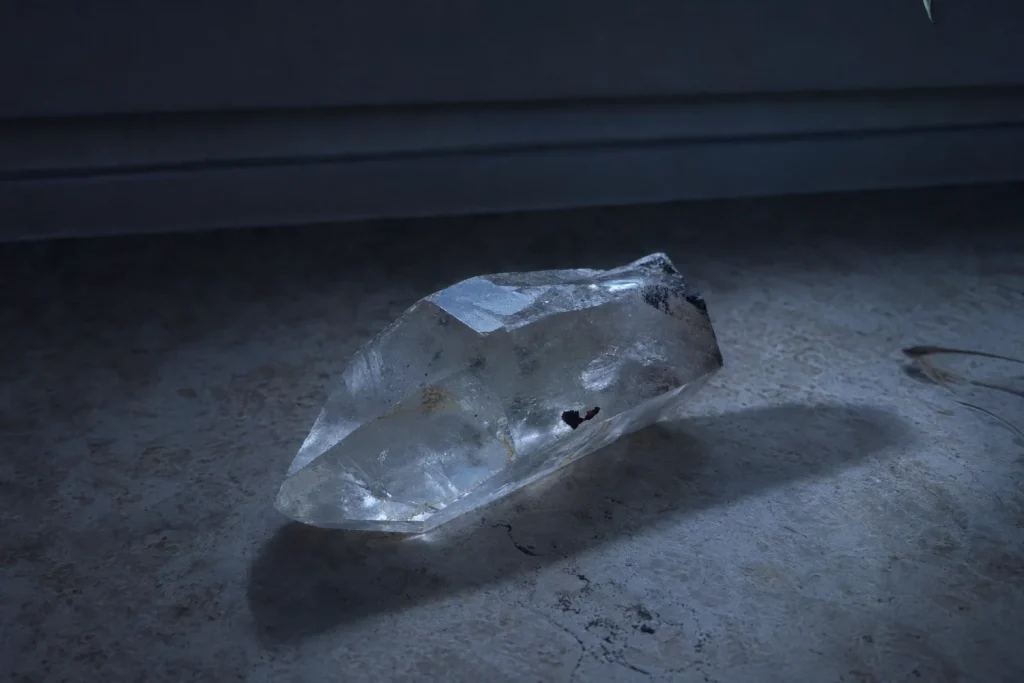
4. Cleanse it. Set the crystal down and name what you are clearing: the last few months, a difficult stretch, or simply a fresh start. One sentence, out loud or in your mind. Both work equally well.
5. Charge it. Pause, then name what you want the crystal to carry forward. Keep it short and specific, like “calm at the end of the day” or “confidence for the new job.” Skip this step if you only want a cleanse.
6. Leave it. An evening is enough, and a whole night is fine. Choose based on when you’ll be up again. If you’re not usually awake before sunrise, an evening session and an early bedtime for the crystal is the safer choice.
7. Collect it. Take it off the sill before the sun reaches it, hold it for a moment, and put it back in its usual place. That is the end of the ritual.
What If It’s Cloudy?
Whether a cloudy full moon still counts is a question of belief rather than light. In crystal practice, some hold that the phase is what matters, so the crystal is charged whether or not you can see the moon. Others wait for a clear night. Choose whichever feels right to you.
If the clouds don’t lift, or the next full moon is about four weeks away (the cycle repeats every 29.5 days), you don’t have to wait for it. A sound session covers the same two steps on any evening: with Crystal Cleanse’s free sessions, you can cleanse and reset a crystal, or cleanse it and charge it with one of six intentions, in your browser or on Android. Sound cleansing also needs no window and no perfect weather.
Moon Water Is a Different Ritual
Moon water is water left out under the full moon, sometimes with a crystal sitting in it. That turns a night of moonlight into an overnight soak, and a long soak is where most water damage starts.
Selenite, malachite and lepidolite should never go in. Jade, lapis lazuli and turquoise depend on how they were treated, and the water-safety list covers the rest stone by stone. If you want moon water, stand the crystal beside the jar rather than in it. The water and the stone share the same moonlight, and nothing has to soak.
Common Questions
Do I Have to Put Crystals Outside?
No. An indoor windowsill is enough, and it keeps the crystal away from dew, rain and anything that might carry it off. If you do put it outside, choose a dry night, use a dish, and bring it in before the dew settles.
Which Crystals Shouldn’t Be Charged Under the Full Moon?
Water-sensitive stones such as selenite need a dry indoor spot, brittle stones need a stable surface, and anything light-sensitive, amethyst included, is best brought in before the morning sun. Leaving amethyst in the sun for a few days won’t damage it, but if you leave it in the sun routinely, its purple color can fade.
Can I Leave My Crystals on the Windowsill All Month?
You can leave them through the night, but a windowsill also gets the sun every day after that. For light-sensitive stones, that daily sun adds up. Charge them on the sill, then move them back to their usual place.
How Often Should I Charge Crystals Under the Full Moon?
As often as you like. The full moon gives you one natural date a month, which is a steady rhythm if you would rather not decide each time. Cleanse in between whenever there is a reason: a new crystal, someone else has handled it, or you’re starting something new.
* AI was used to assist in the preparation of this article and in the editing of some of its images.