
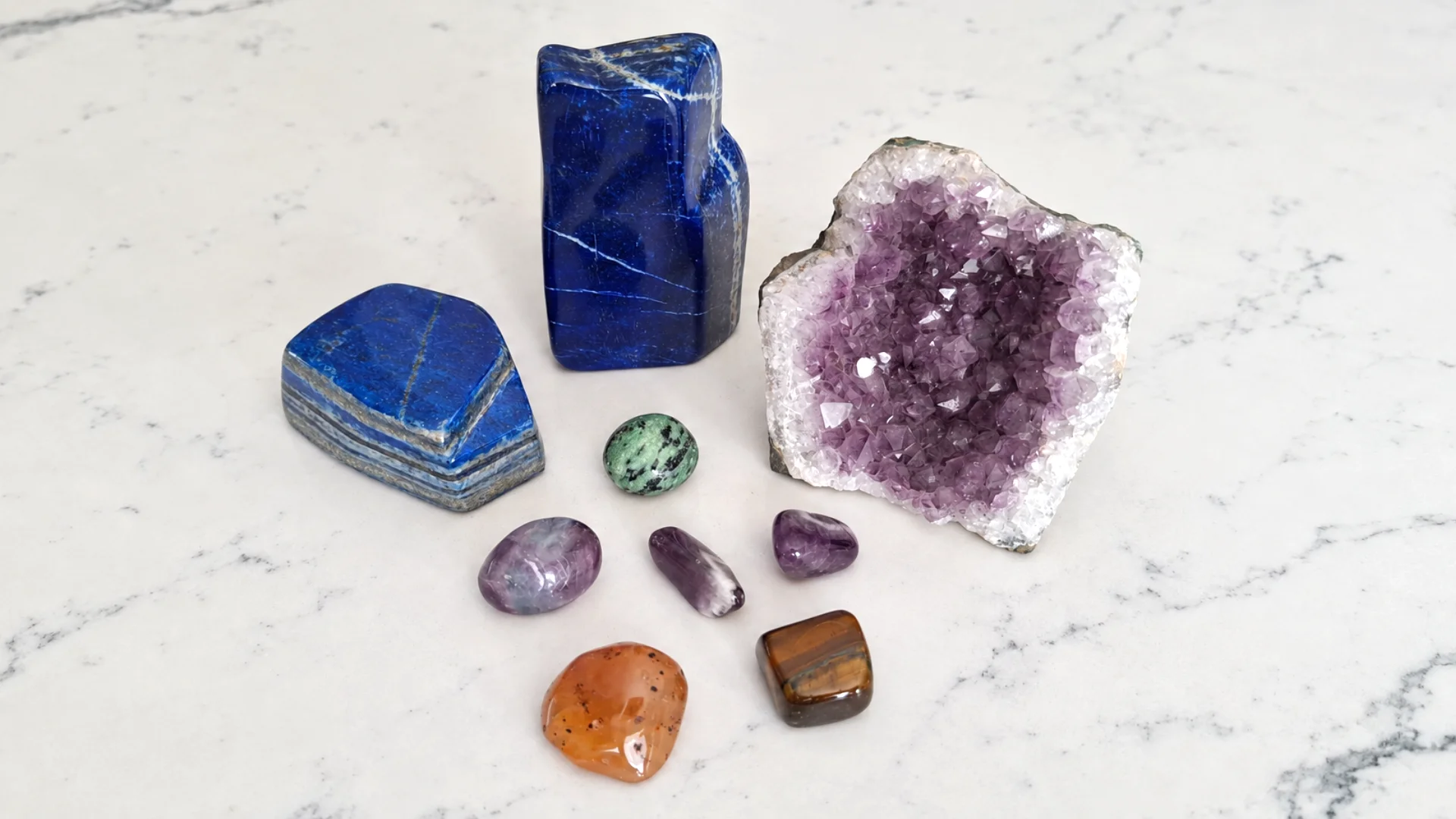

Take the crystal in your hand and turn it over. Look at the rough edges, the hairline cracks, the drill hole, the elastic or the metal holding it in place. You’ll soon notice that the most common advice – hold it under running water – might not suit the piece in your hand.
If you can’t confidently identify all the materials used (like glue, thread, metal, coating, etc.) or even the crystal itself, begin with a non-contact method. Play sound nearby, use your voice, or work with intention alone. Nothing has to touch the stone.
Water is not ruled out forever, only until you know what the object is made of. So start with the object.
Choose the Method from the Object
A crystal is more than its chemical makeup. Its treatment, shape, condition and setting all change what it can safely tolerate. A loose polished stone has different weak points from a raw cluster, and a bracelet has to be judged on every material in it: beads, cord, knots and clasp.
| What is in your hand? | Start here | Check before using contact methods |
|---|---|---|
| An unidentified loose stone | Sound played nearby with various instruments, your voice, or a sound recording | The mineral’s identity, treatments and condition |
| An identified loose stone in good condition | Any method confirmed as suitable for that mineral | Cracks, coatings, dye, filling and light sensitivity |
| A raw, soft, flaky or fractured piece | A non-contact method | Stability, cleavage and whether loose grains or points could break away |
| A bracelet, pendant, ring or other constructed object | Sound played nearby with various instruments, your voice, or a sound recording | Every material present, including elastic, thread, glue, and/or metal |
Do not use a single Mohs number as permission to soak, scrub or leave a stone in the sun. Hardness describes resistance to scratching. Gem durability also includes toughness and stability – how readily a material chips, and how it responds to heat, light, chemicals and humidity.
When the seller cannot identify the material or tell you how it was treated, uncertainty is part of the object. Choose around it.
How the Crystal Changes the Method
Most collections contain some version of these four: an unlabeled stone, a soft mineral, a light-sensitive stone and a piece of jewelry. Each one changes what is safe to do.
1. The Unknown Stone
Perhaps it came without a label, or you have forgotten what it is. Perhaps the color suggests three possible minerals, or the surface may have been dyed or coated. Guessing is not enough for contact care.
Use sound nearby or hum while you hold the intention of cleansing the crystal. If it also needs physical cleaning, have the seller or a qualified gem professional identify it first where that is possible. An AI tool (ChatGPT, Claude, Gemini and others) can suggest what a common stone might be, which gives you a name to search. It is still a guess from a photograph, so it does not settle whether the stone can get wet.
2. The Selenite Piece
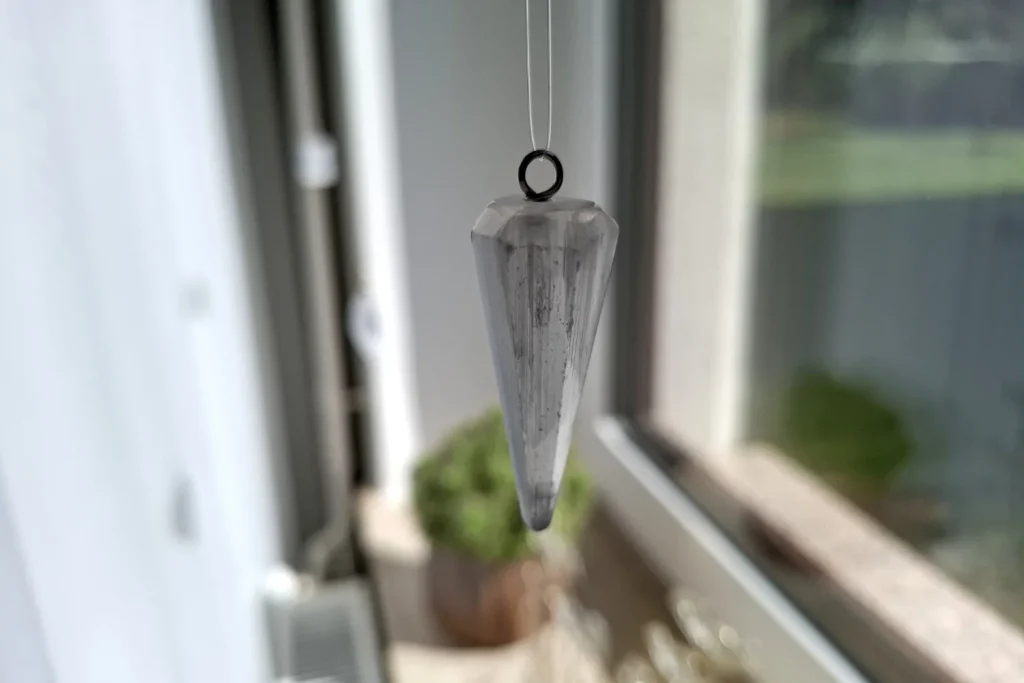
Selenite is a crystalline form of gypsum. Water dissolves a little of it, and it splits into layers along flat internal planes – the property mineralogists call perfect cleavage. These are material properties, not spiritual ones.
Keep it dry. Sound or humming will carry the ritual without asking the mineral to tolerate water.
3. The Amethyst
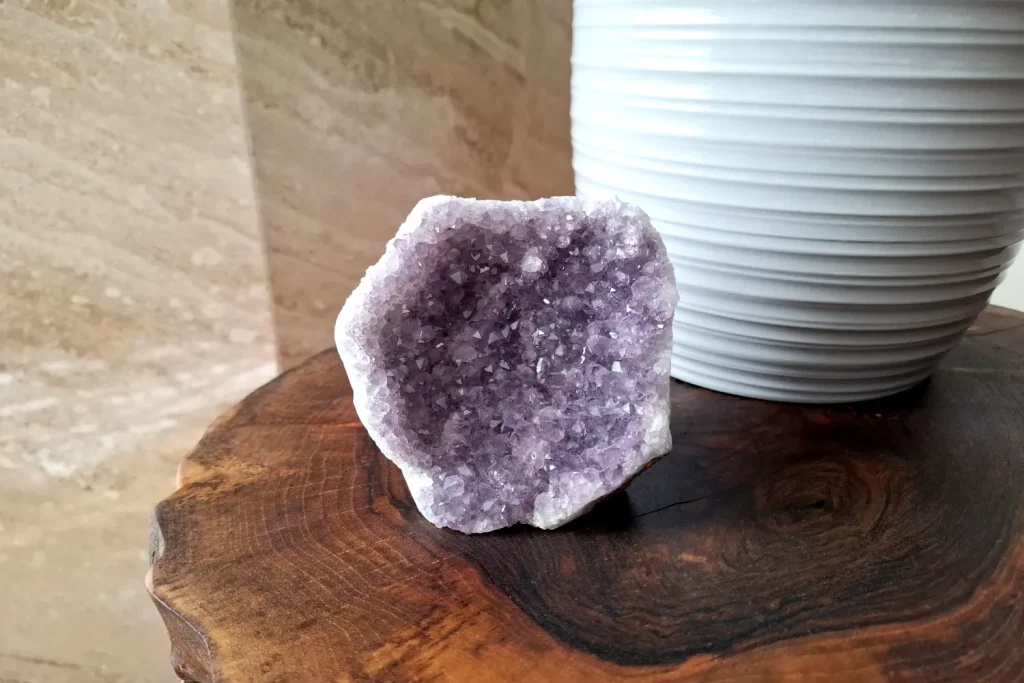
Amethyst is durable enough for many forms of jewelry, but durability does not make it indifferent to light. GIA’s amethyst care guide notes that some amethyst color can fade after prolonged exposure to intense light.
Cleansing amethyst without fading it comes down to one habit: a long afternoon in a south-facing window is the one worth breaking.
4. The Bracelet
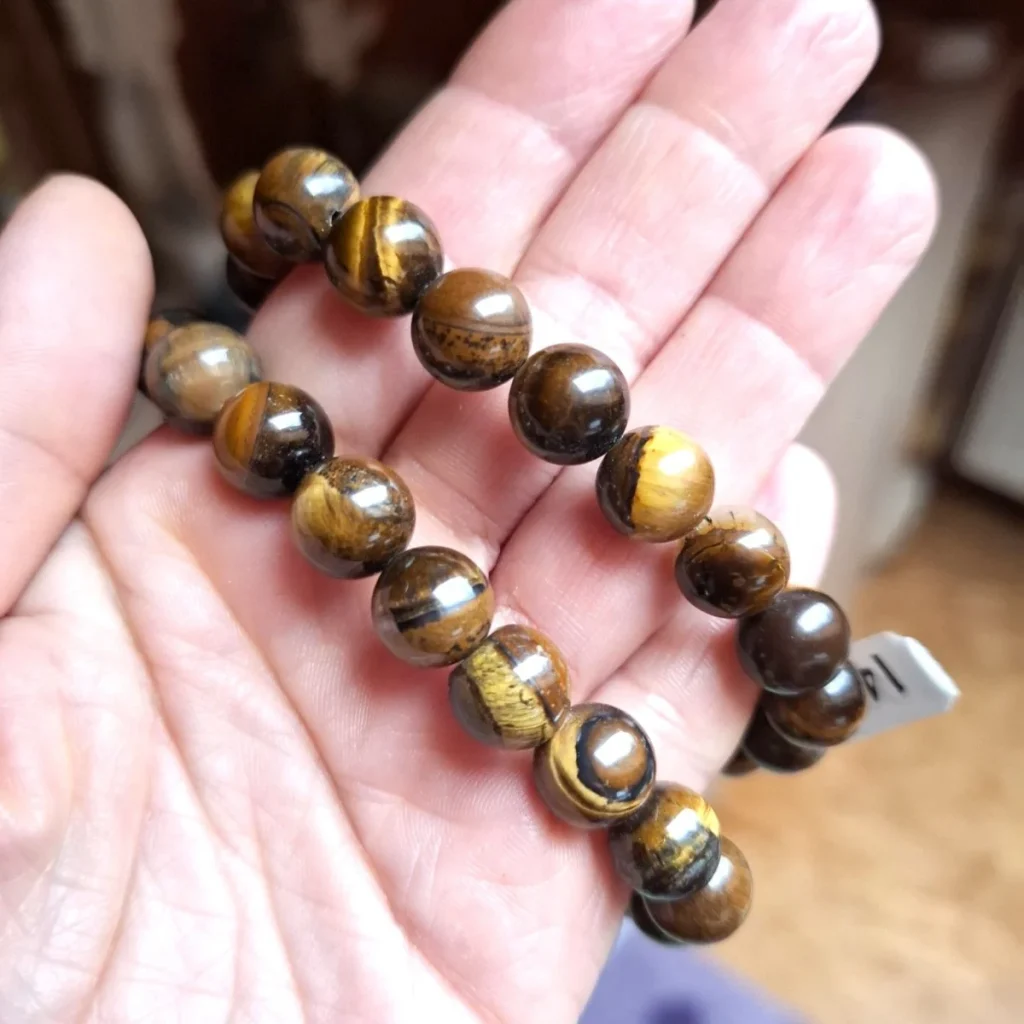
The beads may tolerate a method that the elastic, thread, glue, clasp or finish does not. Water sits inside drill holes. Fine salt and soil lodge between beads. Smoke leaves its smell in cord.
Treat the bracelet as one object, and let sound reach it where it lies.
Cleansing Is Not Physical Cleaning
In crystal practice, cleansing clears accumulated energy and creates space for a fresh intention. Physical cleaning removes dust, skin oil, fingerprints and residue. They answer different needs.
A sound session can complete the ritual and leave a dusty surface exactly as it was. Where a crystal needs both, do both – separately, and in whichever order suits you.
The Main Crystal-Cleansing Methods
Most cleansing traditions return to the same small group of elements: sound, moonlight, smoke, water, sunlight, salt, earth, other crystals and intention.
You don’t need to combine the methods. One method you actually perform is worth more to a practice than nine you have read about. Mixing them is fine once you know the piece tolerates each one.
Sound
Place the crystal on a stable surface and ring a bell, play a bowl, hum, clap or use a recording nearby. Cleansing with sound asks nothing of the stone, which makes it the easiest starting point for a mixed collection.
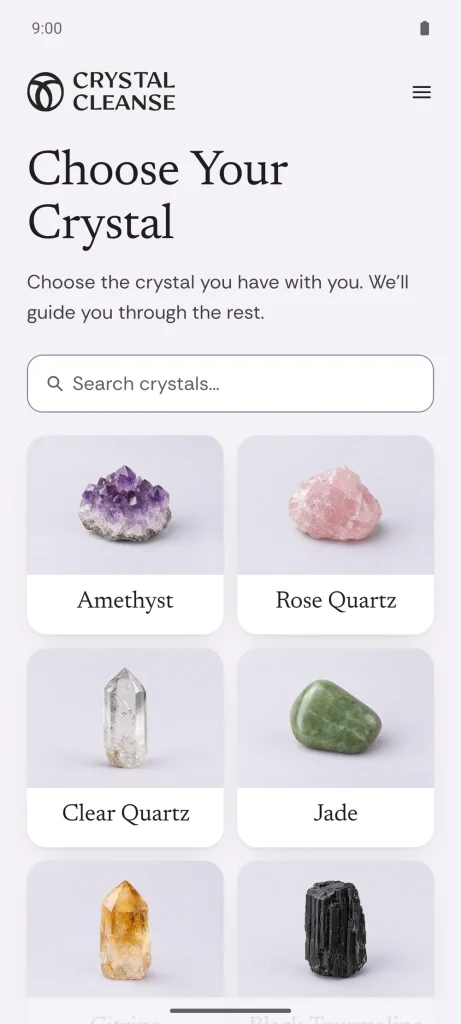
Any of them works. What gives the ritual its shape is the beginning and the end: the sound starts, you stay with it, the last tone closes it. If you want a session ready to play, try Crystal Cleanse’s free guided sound sessions – in your browser or on Android.
Moonlight
Put the crystal where moonlight reaches it and rain does not. A dry windowsill answers for most homes. Watch for dew through an open window, and for anything a cat can knock off a ledge. Use the full moon if it means something to you.
Smoke
Sage, incense, palo santo or a premade herb bundle all work. Light it, let the flame go out, then pass the crystal through the rising smoke or move the smoke around it. Keep the stone away from the flame.
Darija Huzimec, our crystal expert, cleanses mostly with loose dried herbs and palo santo. Her short Instagram video covers the process.
A palo santo stick usually goes out on its own and wants relighting. A bundle smolders on and sheds embers, so it needs a dish under it the whole time. Use a fireproof holder, ventilate the room, and finish the ember completely. Skip smoke where burning is unwelcome, or where cord and fabric will hold the smell for weeks.
Water
Use water only when you know the exact mineral and every other material in the object can tolerate it. Check for dye, coatings, fillers, glue, metal, thread and existing fractures before anything gets wet.
A few stones never tolerate it: selenite, malachite and lepidolite should stay dry, and jade, lapis lazuli and turquoise depend on how they were treated.
Then keep it brief. Hold the piece under clean running water or dip it in a bowl, and dry it properly afterward.
A long soak is where most water damage starts. A few minutes is plenty.
Sunlight
Sunlight gives a ritual a clear hour and a clear atmosphere. It also fades some gem materials – amethyst among them, though that takes weeks of direct exposure rather than a few afternoons – and cracks others through sudden temperature change. Use it when the material, treatment and condition are known to be light-stable. Otherwise move the ritual indoors.
Salt
Salt has a strong place in cleansing traditions and an awkward habit of getting into cracks, drill holes and settings. Direct contact is rarely worth that complication.
If salt matters to your ritual, put it in one dry dish and stand the crystal in a separate smaller dish above or beside it. The materials stay apart and the symbolism survives.
Earth
Earth burial suits a slow ritual. Loose soil brings moisture, grit and a real chance of losing a small stone, so bury a dry, closed container rather than the crystal itself, and mark the spot. Nothing set in metal, nothing unidentified and nothing you would grieve over goes in the ground.
Other Crystals
Some traditions use selenite, clear quartz or a large cluster to cleanse other stones. Set the pieces side by side, or use a plate big enough to support the crystal without balancing it on points.
Crystals scratch and chip each other. Put them down gently and keep the hard edges apart.
Intention, Prayer or Visualization
Set the crystal in front of you. Name what you are clearing, say a prayer, picture the energy leaving, or hold one steady thought until the ritual feels complete.
Nothing is required but attention, which is why this is the method left when the object is fragile, unidentified, or somewhere you cannot make a sound.
A Simple Ritual for Any Safe Method
1. Check the object. Identify the mineral if you can. Look for damage, treatments and every non-stone component.
2. Choose the place. Use a stable, uncluttered surface. Move water, flame and loose stones away unless they belong to the method and are safe there.
3. Set the intention. Name what you want to clear and what you want to make space for. One sentence, out loud, or in your mind only. Both work equally well.
4. Begin the method. Ring the bell, place the stone in moonlight, guide the smoke, use water where confirmed safe, or sit with the crystal and your intention. Stay present instead of leaving the ritual to happen in the background.
5. Close it. Finish deliberately: let the last sound fade, take the crystal off the windowsill, put the ember out, or breathe once before you set the stone back down. Anything can work – from a couple of minutes to half an hour. No need to drag it out.
How Often Should You Cleanse Crystals?
There is no universal schedule. The common moments are bringing a new crystal home, letting someone else handle it, setting a new intention, coming out of a demanding stretch, or simply feeling ready to begin again.
Cleanse when there is a reason. Once a month is a steady rhythm if you would rather not decide each time.
Is Cleansing the Same as Charging?
The language overlaps between traditions. A useful working distinction is that cleansing clears what has accumulated, while charging or setting an intention gives the crystal a direction for what comes next.
Both can happen in one sitting. Clear first, pause, then name what you want carried forward. If you do not want to set an intention, the cleansing alone is enough. In crystal practice it returns the stone to its own character, ready for whatever you bring to it next.
Begin with the Safest Choice
If you know the crystal and trust the method, use it. If you do not, leave water, salt, soil and strong sunlight alone and choose something that works at a distance.
Sound is the simplest place to begin.
* AI was used to assist in the preparation of this article.