
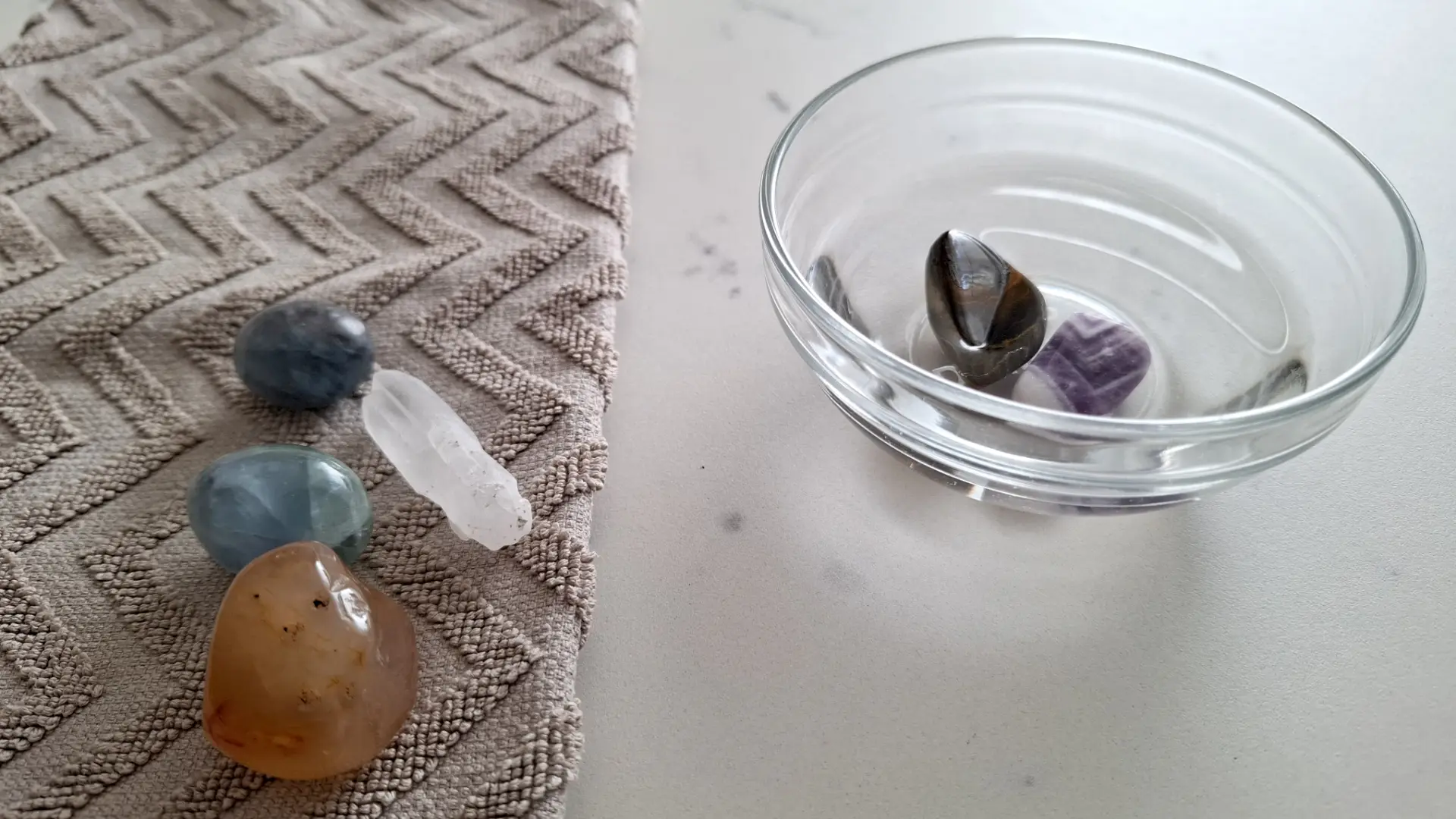

Leave a piece of selenite in a bowl of water overnight and you are not cleansing it. You are dissolving it.
For a small number of crystals, the question in this guide’s headline is completely justified. For most of the rest, the advice circulating online would not get a seal of approval from a gemmologist.
In crystal practice, cleansing clears what practitioners believe to be “negative energy” and makes room for fresh intentions. In this guide, however, we’ll talk only about which stones survive contact with water and which don’t – not how to cleanse a crystal once you know that it can.
The Short Answer
Listed below are arguably the most popular stones among buyers and collectors. The ones that should stay dry are selenite, malachite and lepidolite. For three more – jade, lapis lazuli and turquoise – you need to check what was done to them before you bought them.
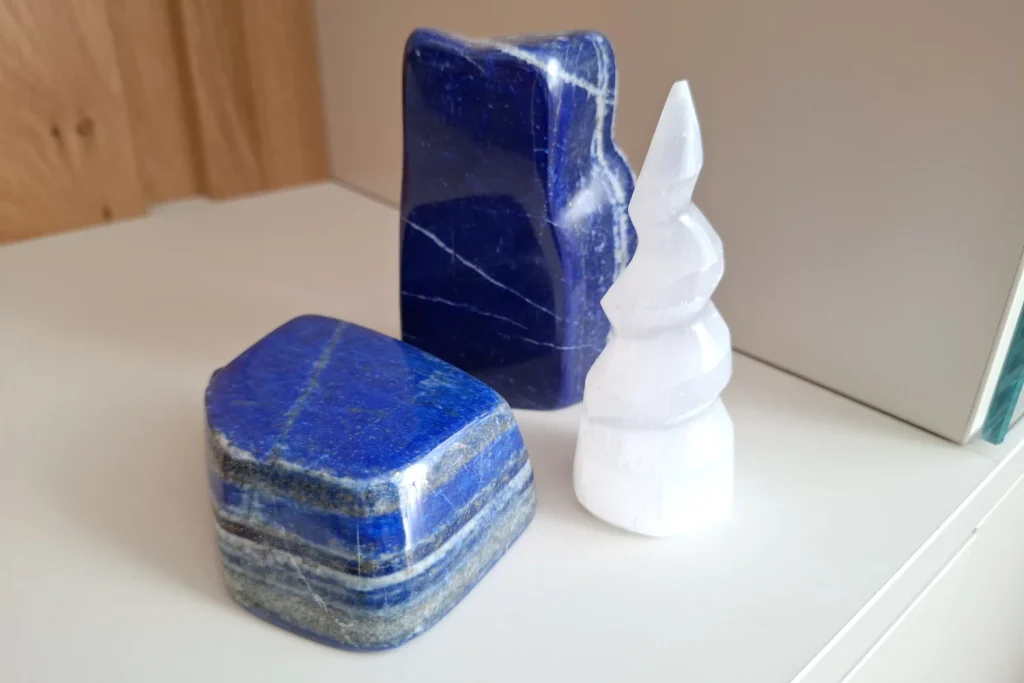
Everything else tolerates brief contact with clean water if dried properly afterward.
The type of stone isn’t always the issue; sometimes, how it was treated is.
Water Safety, Crystal by Crystal
These twenty-four crystals are popular among buyers and collectors and are ranked by popularity based on Google Search insights. Each verdict assumes a loose stone in good condition. A cord, a setting, a coating or a crack overrides it.
Here, safe, brief means a quick rinse is suitable for a loose stone in good condition. Brief only is the more cautious verdict: use water only when needed because the stone’s structure demands extra handling care. Neither label means it should be soaked.
| Crystal | Water | What decides it |
|---|---|---|
| Amethyst | Safe, brief | Quartz, Mohs 7. Prolonged strong light fades it; water does not. |
| Rose Quartz | Safe, brief | Quartz. Commonly full of internal fractures, so dry it rather than letting it sit wet. |
| Clear Quartz | Safe, brief | Quartz. The default yes on this list. |
| Jade | Check first | Untreated jadeite and nephrite are exceptionally tough. Much of what is sold as jade is bleached, impregnated or dyed. |
| Citrine | Safe, brief | Quartz. Nearly all of it is heat-treated amethyst, and that treatment is stable. |
| Black Tourmaline | Safe, brief | Mohs 7 to 7.5, but often striated and fractured. Raw pieces shed flakes into a bowl. |
| Obsidian | Safe, brief | Volcanic glass. The hazards are sudden temperature change and thin, sharp edges. |
| Tiger’s Eye | Safe, brief | Quartz. Dyed red and blue versions exist; treat an unusual color as a treatment. |
| Lapis Lazuli | Check first | A rock rather than a single mineral, usually waxed, oiled or dyed. |
| Moonstone | Brief only | Feldspar with cleavage. It is brittle, and impact is the real hazard. |
| Lepidolite | Keep dry | Mica. Mohs 2.5 to 3, with perfect cleavage in one direction. The layers lift. |
| Smoky Quartz | Safe, brief | Quartz. Irradiated material can fade in strong light. |
| Green Aventurine | Safe, brief | Quartz. |
| Malachite | Keep dry | Mohs 3.5 to 4, with perfect cleavage. It reacts with weak acids and is usually waxed. |
| Amazonite | Brief only | Feldspar with cleavage. |
| Labradorite | Brief only | Feldspar with cleavage. The flash sits on internal layers. |
| Fluorite | Brief only | Mohs 4, with four directions of perfect cleavage. It does not dissolve; it chips. |
| Carnelian | Safe, brief | Chalcedony. Routinely heated and dyed, but stable afterward. |
| Sodalite | Brief only | Mohs 5.5 to 6, often veined with softer white material. |
| Rhodonite | Brief only | Mohs 5.5 to 6.5, often veined with softer black manganese oxide. |
| Selenite | Keep dry | Gypsum. It dissolves and splits along perfect cleavage. |
| Aquamarine | Safe, brief | Beryl, Mohs 7.5 to 8. Fracture-filled stones are the exception to watch for. |
| Turquoise | Check first | Porous and almost always stabilized, waxed or dyed. |
| Moldavite | Safe, brief | Natural glass. The risk is handling: brittle sculpted surfaces chip easily. |
Where a row says check first, the object holds the answer. What follows explains how to read it.
Stones Too Reactive for a Starter Collection
The genuinely water-soluble end of the mineral world sits mostly outside a starter collection. It is also where this question came from, so these stones are worth knowing.
| Stone | Water | What decides it |
|---|---|---|
| Halite | Never | Rock salt. It dissolves completely, which is the whole point of it. |
| Selenite, satin spar, desert rose | Never | All gypsum, all soluble. The trade name changes; the mineral does not. |
| Angelite | Never | Anhydrite is calcium sulfate without its water. Add water and it starts turning into gypsum. |
| Pyrite | Never | Moisture drives oxidation that makes specimens crumble and smell of sulfur, and it does not stop once it starts. |
| Celestite | Keep dry | Mohs 3 to 3.5, and usually a delicate geode cluster held together by very little. |
| Azurite | Keep dry | A copper carbonate like malachite, but softer. It can alter into malachite in damp conditions. |
| Calcite | Keep dry | Mohs 3, and it reacts with even weak acids. The polish dulls first. |
| Opal | Brief only | Hydrated silica with very poor to fair toughness. Heat and sudden temperature change craze it. |
| Amber | Brief only | Fossil resin, soft, and solvents attack it. |
| Pearl | Brief only | Nacre over an organic core, drilled and strung on silk that water ruins first. |
What Makes a Crystal Safe for Water?
Many lists of crystals that can’t get wet are sorted by hardness and draw a line at Mohs 5. However, hardness tells us only how easily a mineral can be scratched.
To judge whether a stone is water-resistant, gemmologists look at its stability. By “stability”, they mean how well it withstands water, heat, light, humidity and household chemicals.
Start with these four questions when deciding whether your gemstone can be washed with water.
1. Does It Dissolve?
Luckily, the list of gemstones that dissolve is very short. Here the water itself is chemically the problem, and not a mere complication.
The crystal you can never put in the water is selenite, because it’s a crystalline form of gypsum. Every time you’d sink the stone, water would dissolve it, little by little, and it splits into sheets along flat internal planes – the property mineralogists call perfect cleavage.
Halite dissolves outright. Anhydrite, sold as angelite, is the form of gypsum without its water, and putting it in water invites the reaction it is named for.
Nothing else you might usually own gets on this list.
2. Can It Split or Flake?
Lepidolite is a mica, and micas split into thin sheets. A raw or flaky piece can shed at the edges, which is why it belongs in the keep-dry group.
Fluorite has four directions of perfect cleavage and can break into neat octahedra when it is knocked. Moonstone, labradorite and amazonite are feldspars with cleavage in two directions. For these stones, impact is the main risk.
If you rinse one, handle it gently and dry it straight away.
3. Is It Porous?
Turquoise absorbs what it touches. GIA’s turquoise care guidance records that it dissolves slowly in hydrochloric acid, that it can be discolored by chemicals, cosmetics, skin oils and perspiration, and that steam and ultrasonic cleaners are never safe for it. Raw lapis lazuli is porous for a different reason: it is a rock rather than a single mineral, built from several minerals of different hardnesses, and the softer ones give water somewhere to go.
A porous stone keeps what it absorbs. That includes soap.
4. What Was Done to It Before You Bought It?
This decides more of these cases than mineralogy does, and it is the one thing a stone’s name will never tell you.
Lapis is commonly dyed, and GIA notes that some dye treatments are not stable and that the wax used to seal them deteriorates when it meets heat or solvents. Their guidance is to test an inconspicuous area first. Jade may be bleached, impregnated with polymer, dyed or coated, which is why GIA recommends warm soapy water for jade of unknown treatment even though untreated jade tolerates a great deal more.
A dyed stone can bleed. A waxed stone dulls. A polymer-impregnated stone is only ever as water-safe as the polymer.
If the seller could not tell you how a stone was treated, that uncertainty is part of the object. Choose around it.
[ORIGINAL IMAGE NEEDED – a close-up of a real treated piece from the collection, framed so the evidence is visible: dye pooled in a drill hole, a wax sheen at the edge of a polish, or color sitting only in the surface pits. This section argues from something a photograph can prove and a paragraph cannot. Confirm the stone’s identity and treatment before captioning, and say plainly if the treatment is suspected rather than confirmed.]
Then Check the Cord, Setting and Stand
Beads, cord, elastic, knots, glue, plated metal and drill holes each have their own answer. The strictest one governs the whole piece. Water will sit inside a drill hole long after the bead looks dry.
A Rinse Is Not a Soak
Here is the contradiction worth resolving. GIA recommends warm, soapy water for both turquoise and lapis lazuli – two stones near the top of almost every “never get wet” list written for crystal owners.
The two sides are describing different acts. Gem care means a supervised clean lasting a minute or two, followed by drying. Crystal cleansing usually means something else: a stone left in a bowl overnight, a jar of salt water, a dish of moon water on a windowsill until morning.
Duration is the variable nobody names, and it does most of the damage.
What is dissolved in the water matters nearly as much. Salt is harder on stones than plain water and finds every crack and drill hole. Soap gets into porous material and stays. So does the mineral scale in hard tap water, which dries as a film on a dark polished stone.
Where a stone is confirmed safe and you want to use water, keep it under a minute, clean, lukewarm and supervised. Then dry it fully.
If It Already Got Wet
1. Take it out now. Contact time is the only variable still under your control.
2. Blot, don’t rub. Press with a soft cloth. Rubbing a surface that has softened is what leaves the mark.
3. Dry it fully, away from heat. A radiator or a hairdryer trades one problem for cracking. Air and patience instead.
4. Check the parts you cannot see. Drill holes, the underside of a cabochon, the seat of a setting, the knot in a cord. If your stone is mounted on a metal stand, make sure to check every single cavity of the metal.
5. Look for three specific signs. A dull or chalky patch where the surface was glossy. Color on the cloth. A bead or stone gone loose.
Some of this is recoverable and some is not. A lapidary can re-polish a dulled surface. Dye that has bled is gone, wax that has lifted has to be redone, and a dissolved selenite surface does not come back.
We have selenite that hangs with our curtains. But I’ve never put it into water, so I can’t show you what that looks like.
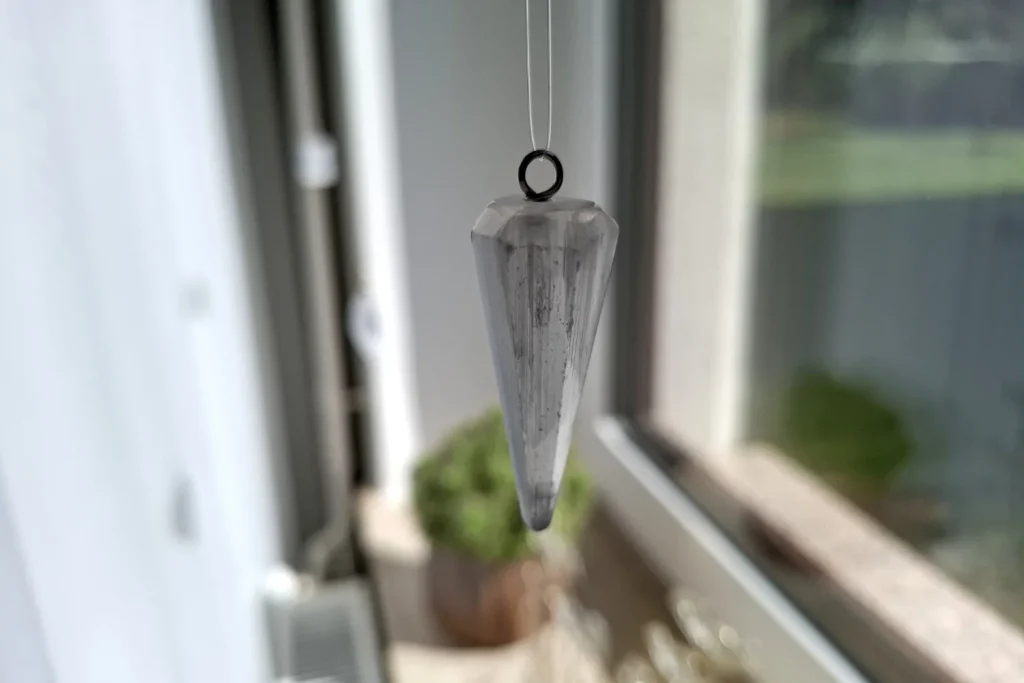
My selenite stones were fairly cheap, and even so, I don’t want to damage them just to show you what damaged selenite looks like. You’ll have to trust me on this one. What we do is dust it with a dry microfiber cloth, and that is it. We don’t even use a wet cloth on it.
When You Cannot Identify the Stone
Most collections hold at least one stone that arrived without a label, or whose label was lost years ago. None of this page applies to it. A guess from a photograph gives you a name to search, not permission to put it in water.
There is a way around the whole question: choose a method that never touches the stone. Cleansing with sound reaches an unidentified crystal, a flaking one, and a bracelet with three unknown materials in it, and asks nothing of any of them. You can try our Crystal Cleanse app when you need to cleanse (not physically clean) your crystals.
* AI was used to assist in the preparation of this article.