
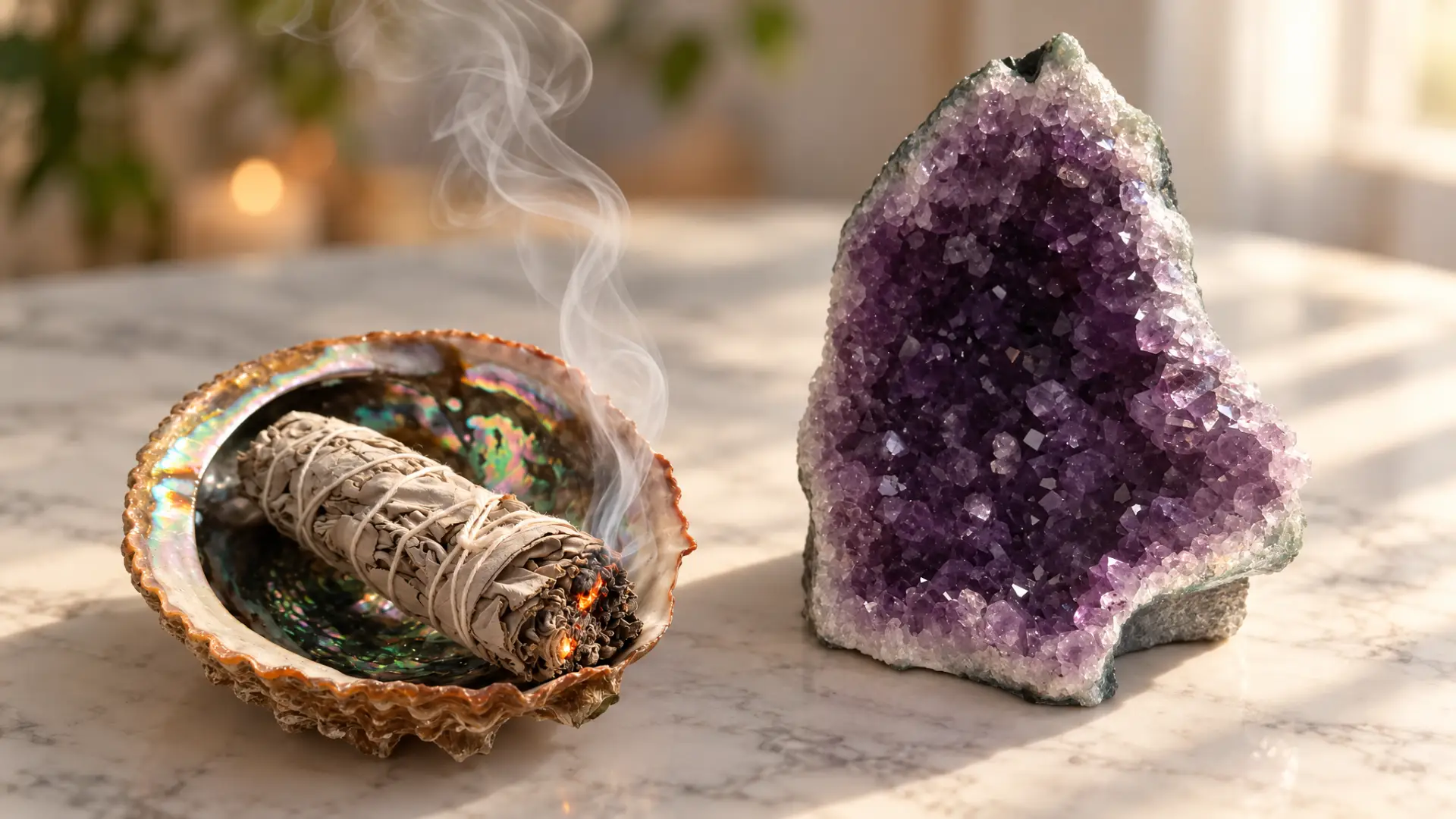

Smoke makes a cleansing ritual visible. It rises, curls around the crystal and disappears, giving your intention something to follow with your eyes.
The method is short. You only need to put the crystal on a stable surface and light sage, palo santo or a herb bundle. Put the flame out, then circle the smoldering end around the crystal a few times. If the crystal is small, you can even hold it in your hand while you do it. Once you are done, ventilate the room to clear the smoke and the smell.
In practice, you don’t need to use a lot of smoke. More smoke has never meant a more cleansed crystal.
In crystal practice, smoke clears what a stone has gathered and marks a fresh beginning.
The Ritual, Step by Step
1. Set Everything Up Before You Light Anything
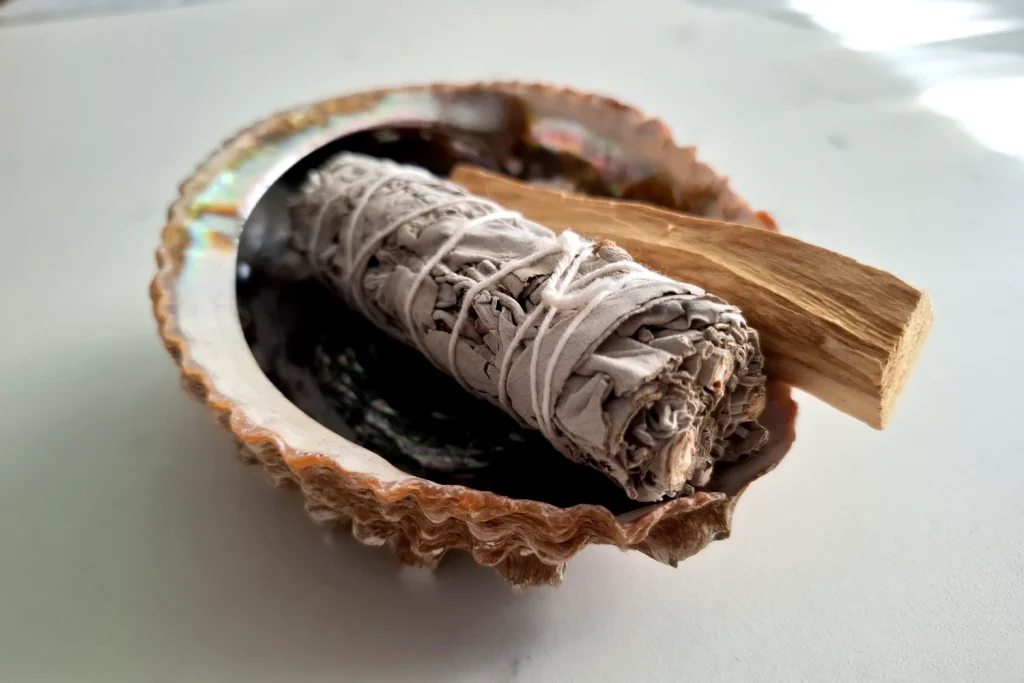
Once something is burning, you should not be hunting for a dish, wrestling with a stuck window or sliding paper out of the way.
You need:
- the crystal;
- an incense stick or cone, a palo santo stick, or a dried herb bundle;
- a holder made for that material, deep enough to catch falling ash and hold an ember;
- a stable, heat-resistant surface, clear of paper or anything else that could catch fire;
- ventilation – an open window or an extractor; and
- the maker’s instructions for putting that particular product out.
Keep children and pets out of the room. Leave smoke alarms working and uncovered. If the room cannot be ventilated, stop here and cleanse without fire.
2. Look at the Whole Object First
Inspect the crystal. It matters whether you are working with a loose polished stone, a raw cluster, or a bracelet made out of several different materials.
Smoke will not hurt a stone the way water can. What it leaves is soot and fine ash, and those settle wherever a surface gives them somewhere to sit. The Canadian Conservation Institute, in its guidance on fire damage, records that organic materials with porous or highly textured surfaces are especially vulnerable and can be difficult to clean. On a piece of crystal jewelry, the organic material is the cord, the thread, the leather and the knot – the parts that hold a smell for weeks. On a raw cluster it is simpler and purely mechanical: deep pockets collect ash the same way they collect dust.
Set anything valuable, coated, flaky or unidentified beside the smoke path rather than in it.
3. Light the End, Then Put Out the Flame
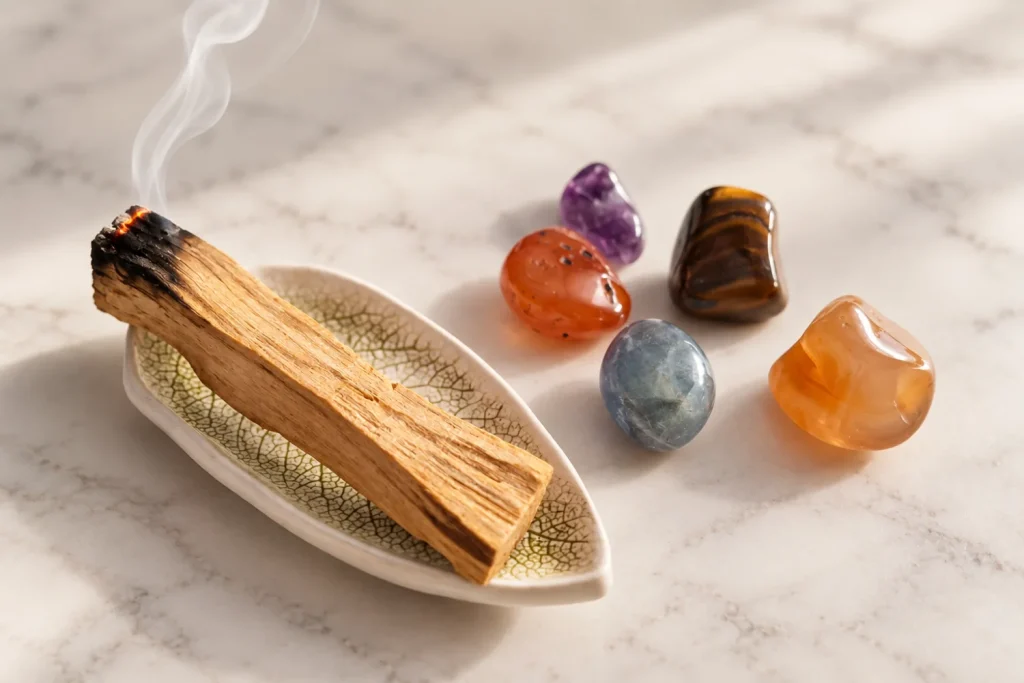
Follow the cleansing product’s instructions. Light the end, let it catch, then put the open flame out so the material is left smoldering in its holder, or above something that cannot catch fire.
Burnable cleansing products each behave a little differently, and the difference is worth knowing.
A palo santo stick usually goes out by itself and wants relighting. A dense herb bundle does the opposite: it keeps smoldering inside long after the surface has gone dark.
4. Set Your Intention
Take a moment before you bring the crystal near the smoke, or the smoke near the crystal. Name what you want to clear, and what you want to make space for next.
One sentence is plenty: I clear what this crystal has gathered and return it to a fresh beginning. Aloud or silent, both work.
5. Guide the Smoke Around the Crystal
Place the crystal beside the rising smoke, or bring the smoke to the crystal – keeping it far enough from the ember that it never becomes warm and cannot catch falling ash. Let a little smoke pass around all its sides. Do not hold the crystal over the hottest point, and do not aim to coat it.
We recommend a brief, deliberate pass rather than letting a stone sit over an incense stick until it burns down. There is no dose to reach and no compulsory number of circles.
6. Close It, and Put the Ember Out
Put the crystal down away from the burner, and acknowledge the end of the ritual. Then extinguish the sage, palo santo or incense exactly as its instructions direct.
Check it twice: no flame, no glowing point, no warmth that could relight dry material. Leave the ash and the holder on the heat-resistant surface until both are cold, and keep the room ventilated while the smoke clears.
How Darija Huzimec Works with Smoke
Darija Huzimec is our crystal expert at Saluxe and Crystal Cleanse. Her own practice runs through Esenca Vesolja (Essence of the Universe), where she holds sound baths and has also written about cleansing crystals. She puts intention at the center of the process.
She cleanses mostly with loose dried herbs and palo santo. Check her Instagram video about the process, which is very short.
Sage, Palo Santo, Incense or Resin?
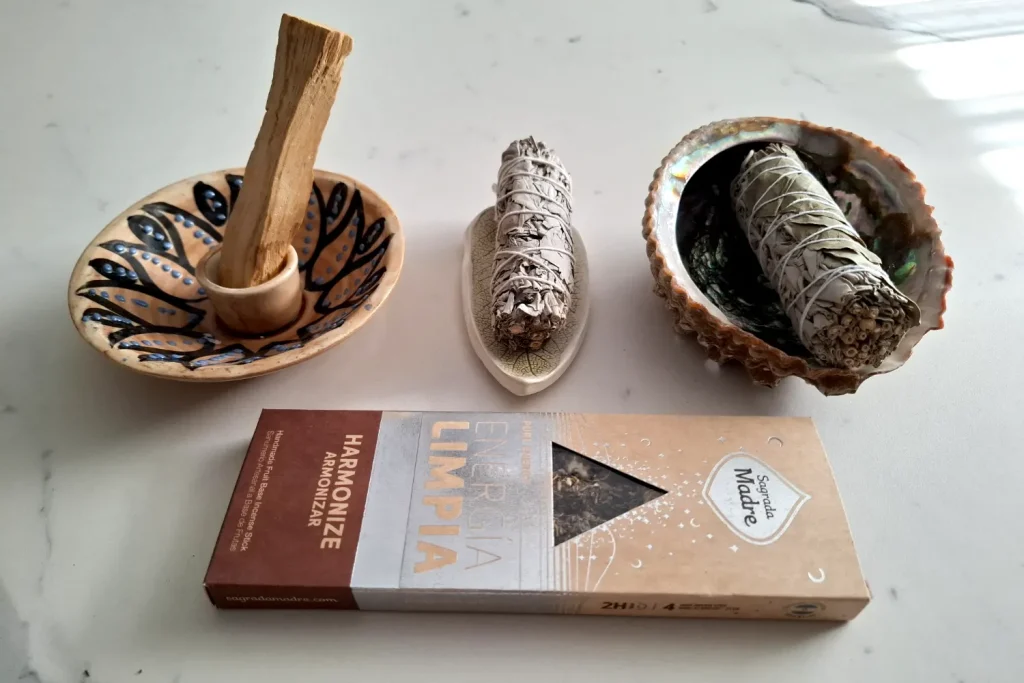
The ritual does not depend on one plant or one fragrance. Choose by meaning, by sourcing, and by how safely you can control the burn.
| Material | What It Is Like to Use | Practical Limitation |
|---|---|---|
| Dried sage or a sage bundle | A direct herbal smoke, and the easiest material to associate with clearing or release. | A dense bundle can smolder on inside after the surface looks dark. Check that it is genuinely out and cold. |
| Palo santo stick | Wood rather than leaf, so the smoke is resinous, and one stick burns only briefly. | It usually goes out on its own and needs relighting, so it is easy to leave a stick you believe is finished. Sourcing is the larger question – see below. |
| Incense stick | The easiest to secure in a purpose-made burner, with a narrow and predictable ash path. | Fragrance and binders vary by product. Use one you already tolerate, and follow the maker’s instructions. |
| Incense cone | Compact and stable in the correct burner. | Heat and smoke are concentrated in one spot, and a cone stays hot after it looks spent. |
| Loose herb or resin on charcoal | Abundant smoke, with a long-established place in incense practice. | It adds a very hot fuel and a specialist burner to a simple ritual. We do not recommend it as a beginner indoor method. |
An incense stick is the most manageable place to begin. The holder controls the ember, catches the ash and leaves both your hands free for the crystal and the intention.
White Sage, Palo Santo and the Word “Smudging”
White sage is not a generic name for every kind of sage. Salvia apiana grows naturally in one narrow band of the world – between Santa Barbara and northern Baja California – where Indigenous communities have tended it for thousands of generations, and where it holds meanings far beyond those of a store-bought product.
Commercial demand has made it a poaching target. The California Native Plant Society, working with Indigenous partners on its white sage project, records rangers confiscating over 1,000 pounds of illegally harvested sage in single incidents and an estimated 20,000 pounds poached across five years – and nearly half of all wild populations already lost to development.
So if you want to use white sage, choose sage that was cultivated rather than picked in the wild. A cultivated bundle takes nothing from those wild populations; a bundle nobody can trace might.
Palo santo raises the same question in a different form, and it gets asked far less often. Either way the buying rule holds: choose a seller who explains where the material came from and how it was collected, and treat an anonymous bundle as an unanswered question.
If your ritual is not part of an Indigenous ceremonial tradition, smoke cleansing is the clearer name for it. Smudging describes specific practices whose materials and meanings are not interchangeable with a general home ritual.
Is Smoke Safe for Every Crystal?
No, it’s not.
No contact method earns an automatic “safe for every crystal” label. Smoke avoids the dissolving, soaking and light-fading problems of other methods and replaces them with heat, ash and airborne particles.
Keep direct smoke away from:
- rough clusters with deep pockets where ash collects;
- soft, flaky or porous specimens;
- dyed, coated, waxed or resin-filled stones whose surfaces are uncertain;
- jewelry containing thread, elastic, glue, leather or fabric; and
- anything irreplaceable, or difficult to clean professionally.
None of these has to sit out the ritual. Set them farther from the burner and let it happen around them, or choose sound, voice or intention so nothing reaches the surface at all.
When Not to Burn Anything
Any burning material adds particles to the room, even during a short ritual. The US Environmental Protection Agency counts incense among the indoor sources of particulate matter and advises making sure there is proper ventilation before burning candles or incense indoors.
Open a window where that will not blow the ember about, or use mechanical ventilation, and keep the session short. Stop and choose a method without fire if smoke irritates anyone present, if somebody has been advised to avoid it, or if the building prohibits burning.
Never burn sage or incense while somebody is sleeping, and never leave it unattended. Greater Manchester Fire and Rescue Service gives the same core advice for incense and ceremonial burning: a purpose-made holder, a stable heat-resistant surface, distance from anything combustible, ventilation, supervision, and a fully extinguished ember.
Common Questions
Can I Cleanse Crystals with Incense Instead of Sage?
Yes, and the steps do not change: secure the incense in its holder, keep the crystal clear of heat and ash, set an intention, guide a little smoke around it, then put the incense out completely.
The difference is symbolic. Sage, palo santo, sandalwood and frankincense carry different meanings in different practices.
How Long Should a Crystal Stay in the Smoke?
It does not need to stay in it at all. A brief pass marks the ritual and gives fewer particles time to settle.
No clock measures when a crystal’s energy has been cleared. Choose a short sequence you can perform attentively, then close it deliberately.
Can I Cleanse Several Crystals at Once?
Yes. Lay them out with enough room to lift or turn any one of them without knocking the others together, and keep the burner well clear of the group so nothing can fall into it.
Move your attention around the collection. One shared intention works, and so does naming each crystal in turn.
What If Ash or Soot Lands on the Crystal?
Let it cool, then try to blow the loose ash away. For soot, clean it as gently as possible with a little water and soap – but first check that your crystal can get wet, and bear in mind that a porous stone will hold on to the soap too. Hard rubbing is what presses the particles in: the Canadian Conservation Institute’s advice for soot-affected objects is to handle them as little as possible, because handling drives soot further into the surface, and to act promptly, since deposits become harder to remove the longer they sit.
When Smoke Is the Wrong Method
Skip smoke when the room cannot be ventilated, when an ember would be unsafe, when the scent is unwelcome, or when the object will hold the residue. A ritual should not ask you to ignore the room, or the crystal in front of you. The method should follow the object in your hand, and smoke is one of nine.
Sound is the cleanest alternative when you want a method that never touches the stone. Your voice, a bell, a bowl played nearby or a guided sound session in Crystal Cleanse will mark the same movement from clearing to fresh intention, with no flame, ash or scent involved.
* AI was used to assist in the preparation of this article and in the editing of some of its images.